
Dream to Design
What makes my guitars different? You do!
Every guitar I build is a reflection of the person who plays it. From wood selection to bracing pattern and top thickness, each detail is tailored to how you play and the sound you want. The result is an instrument that responds to your touch and helps you sound like the best version of yourself.

Fine Tuning the Sound
I select every piece of tonewood myself, but the real difference happens in the process. Nearly every part of the guitar is brought to its final dimensions with hand tools.
Working by hand lets me hear and feel how each piece of wood responds as I shape it. That’s how I get the best tone from every top, back and brace, so your instrument sounds rich, balanced and right for you.

Connecting It All Together
Once each piece is shaped, it has to be joined with precision. I use traditional wood-to-wood joints throughout, fitted closely to minimize energy loss and maximize resonance.
A hand-fitted dovetail neck joint, braces mortised into solid bent and laminated linings, and a scarf-jointed headstock combine to make a guitar that’s both stronger and lighter, and that vibrates as a single, unified system. You’ll feel the difference in every note.

Traditional Methods
I build with time-honored joinery and materials, choosing the methods that produce the best sound. They take more skill and patience, and the results are worth it.
My guitars are assembled primarily with hot hide glue, the same adhesive luthiers have used for centuries. It dries hard and transfers vibration between parts better than modern glues, helping the whole instrument resonate together for a richer, fuller sound.
Hardware
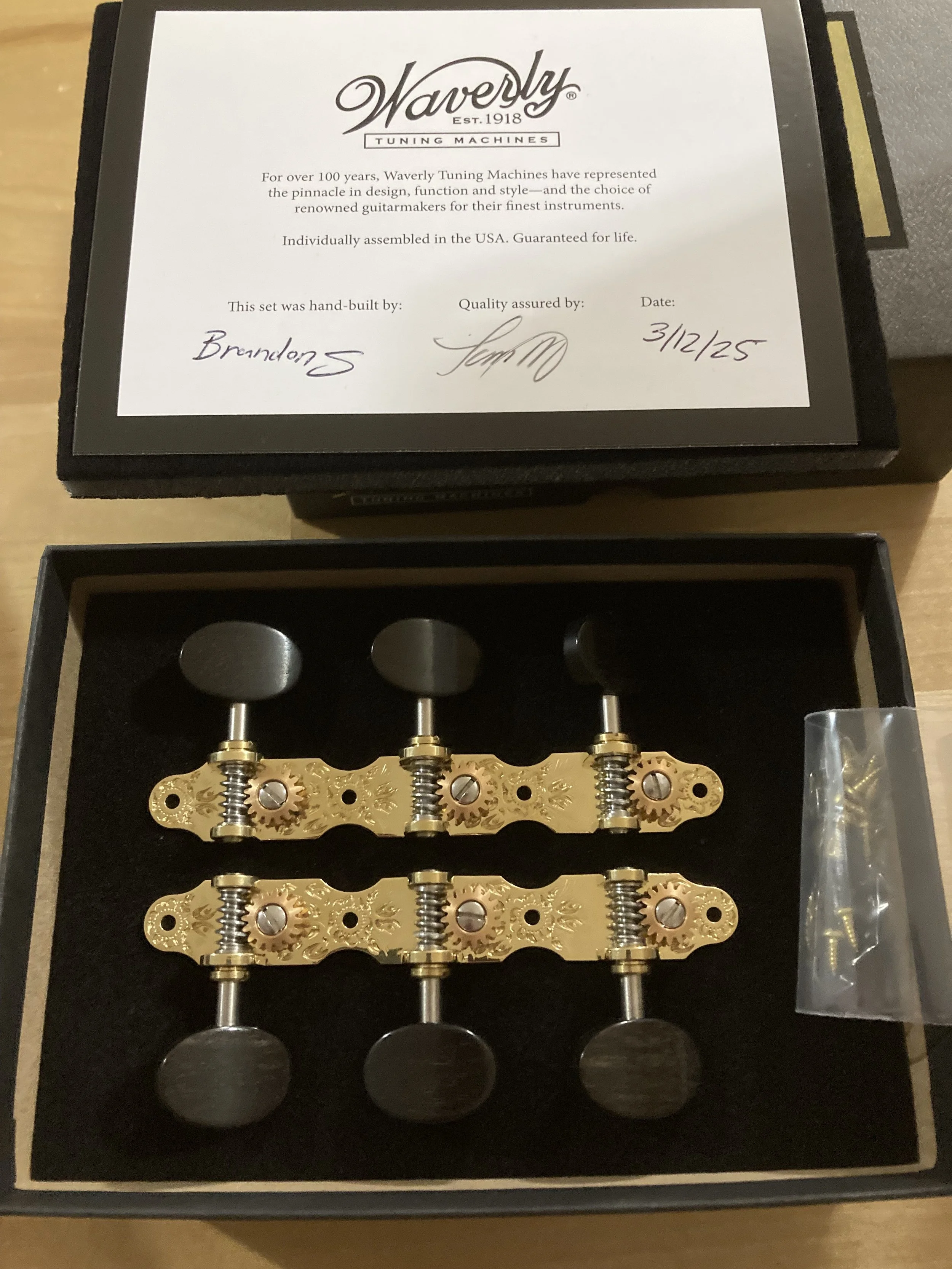
Even the smallest components affect how a guitar looks, plays and sounds. I use bone for the nut and saddle and ebony for the bridge and end pins, natural materials chosen as much for their tonal qualities as for their beauty. Tuners and other hardware are selected for quality and craftsmanship to match the rest of the instrument.

Hand Carved Necks
No two hands are the same, so no two necks should be either. I carve every neck by hand to a profile that fits you, so the guitar feels comfortable from the first time you pick it up.

The Finish
The type of finish matters, but for tone, thickness matters most. The finish on my soundboards is less than 0.002" thick, thinner than a sheet of paper, while still giving durable protection. This lets the top vibrate freely, for long sustain, balanced tone, and clear trebles all the way up the neck.
Ready to Design Yours?
Let’s talk about how you play and the sound you’re after.